
How to Build Cardio Endurance from Scratch: 8-Week Beginner Plan
Cardiovascular endurance is one of the most valuable fitness qualities you can develop — it makes every other physical activity easier, improves energy throughout the day, and has well-documented long-term health benefits.
The good news: you don’t need to be able to run for an hour to start. Building cardio endurance from scratch is entirely achievable with a simple, progressive approach that anyone can follow.
What Cardio Endurance Actually Is
The Basic Physiology
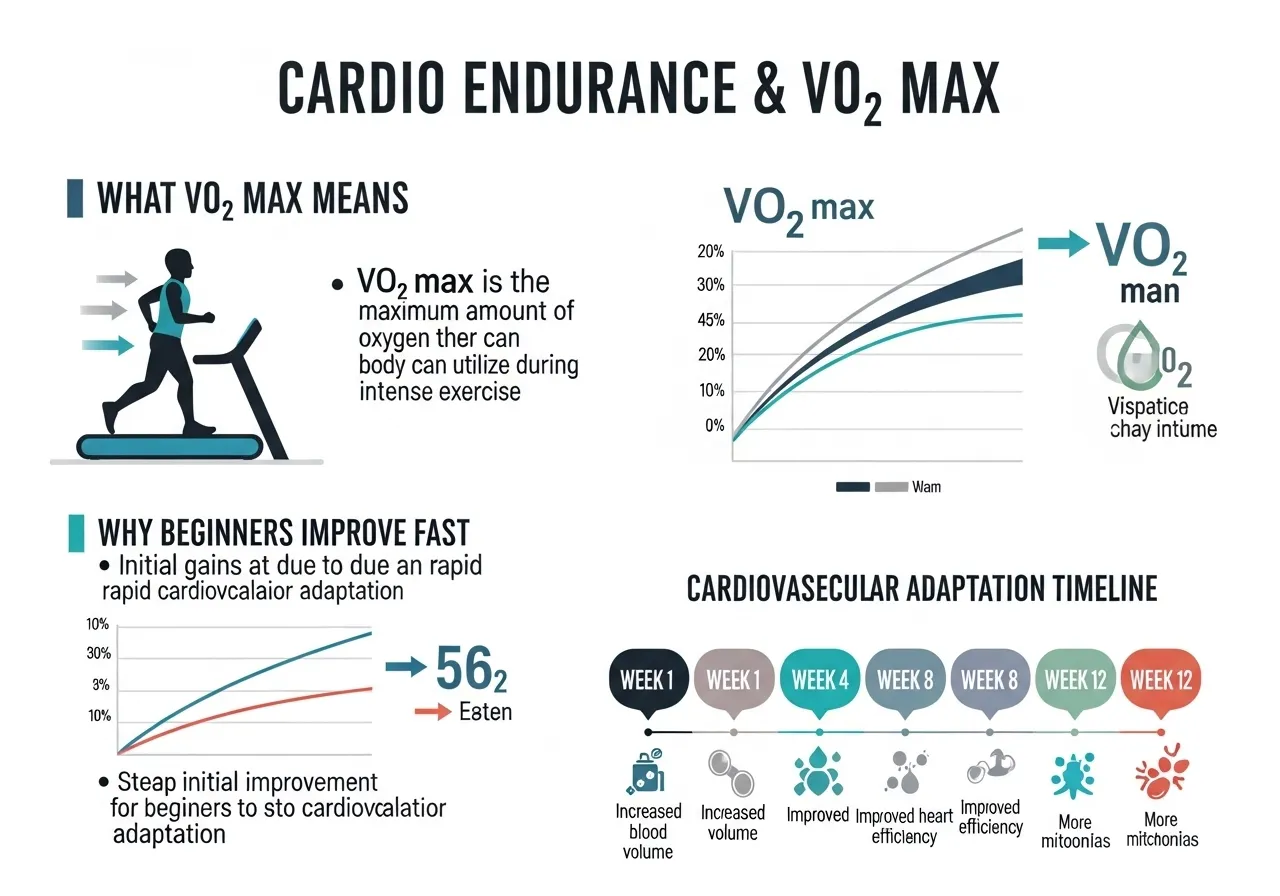
Cardiovascular endurance refers to how efficiently your heart, lungs, and blood vessels deliver oxygen to your working muscles during sustained activity. The fitter you become, the more oxygen your body can deliver and use — meaning the same effort feels easier, and you can sustain higher intensities for longer.
The key measure of cardiovascular fitness is VO2 max — the maximum rate at which your body can use oxygen during exercise. Higher VO2 max means better endurance capacity. The encouraging reality is that VO2 max responds strongly to training, especially in beginners who have the most room for improvement.
Why Beginners Improve So Fast
If you’re starting from a low fitness base, your cardiovascular system can improve dramatically in the first 4–8 weeks of consistent training. The body adapts quickly to new demands when those demands are applied consistently — and early gains are often the most motivating of any fitness journey.
After the first month, the heart becomes more efficient at pumping blood, the muscles become better at extracting oxygen, and the same activity that left you breathless starts to feel manageable. This progression is predictable and reliable when training is consistent.
The Best Cardio Options for Beginners
Walking: The Most Underrated Starting Point
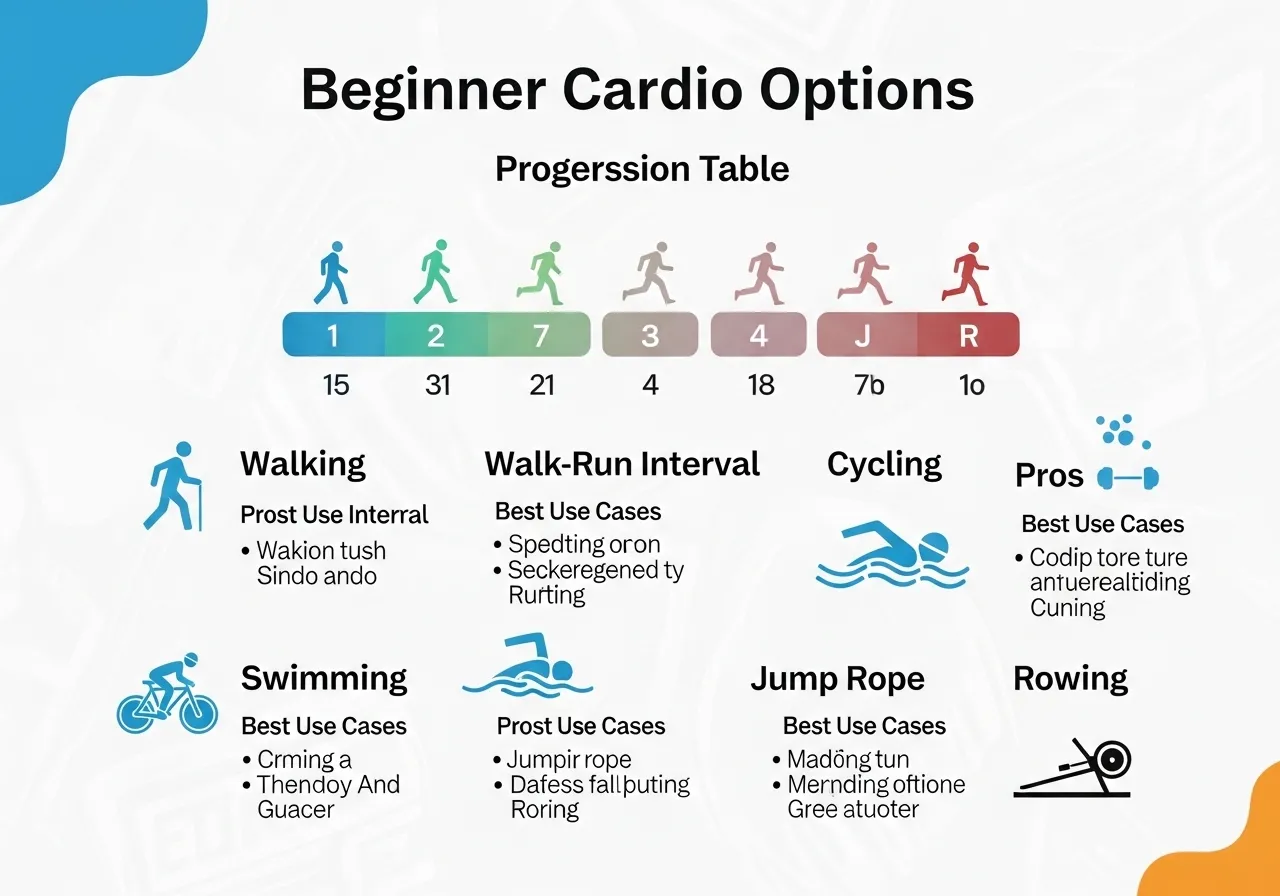
Brisk walking is a genuine cardiovascular training stimulus for deconditioned individuals — it elevates heart rate meaningfully, carries negligible injury risk, and requires no equipment or skill. Many beginners dramatically underestimate how effective consistent walking is for building an initial aerobic base.
Target a pace that makes conversation possible but slightly effortful. A 20–30 minute brisk walk performed 4–5 times per week will produce measurable cardiovascular improvement within 3–4 weeks for most sedentary beginners.
Walk-Run Intervals: The Natural Progression
Once brisk walking feels comfortable, walk-run intervals provide a structured path toward continuous running. The approach is simple — alternate between walking and jogging within the same session, gradually shifting the balance toward more running over weeks.
A practical starting protocol:
- Week 1–2: Walk 4 min / Jog 1 min — repeat 4–5 times
- Week 3–4: Walk 3 min / Jog 2 min — repeat 4–5 times
- Week 5–6: Walk 2 min / Jog 3 min — repeat 4–5 times
- Week 7–8: Walk 1 min / Jog 4 min — repeat 4–5 times
Most people can sustain 20–30 minutes of continuous jogging by week 8–10 of this approach, even if they started unable to jog for more than 60 seconds.
Other Beginner-Friendly Cardio Options
Running is not the only path to cardiovascular fitness. These alternatives offer equally valid routes to the same adaptations:
- Cycling (outdoor or stationary): Very low impact on the joints — ideal for individuals with knee or ankle sensitivity
- Swimming: Full-body, no joint impact, highly effective — the main barrier is pool access
- Jump rope: High intensity, extremely portable, develops coordination alongside cardio fitness
- Rowing machine: Full-body engagement with low impact — one of the most efficient cardio tools available once basic technique is learned
The best cardio option is the one you will actually do consistently. Pick an activity you find at least tolerable and that fits your schedule and environment.
How to Structure Your Cardio Training Week
Frequency and Duration Guidelines
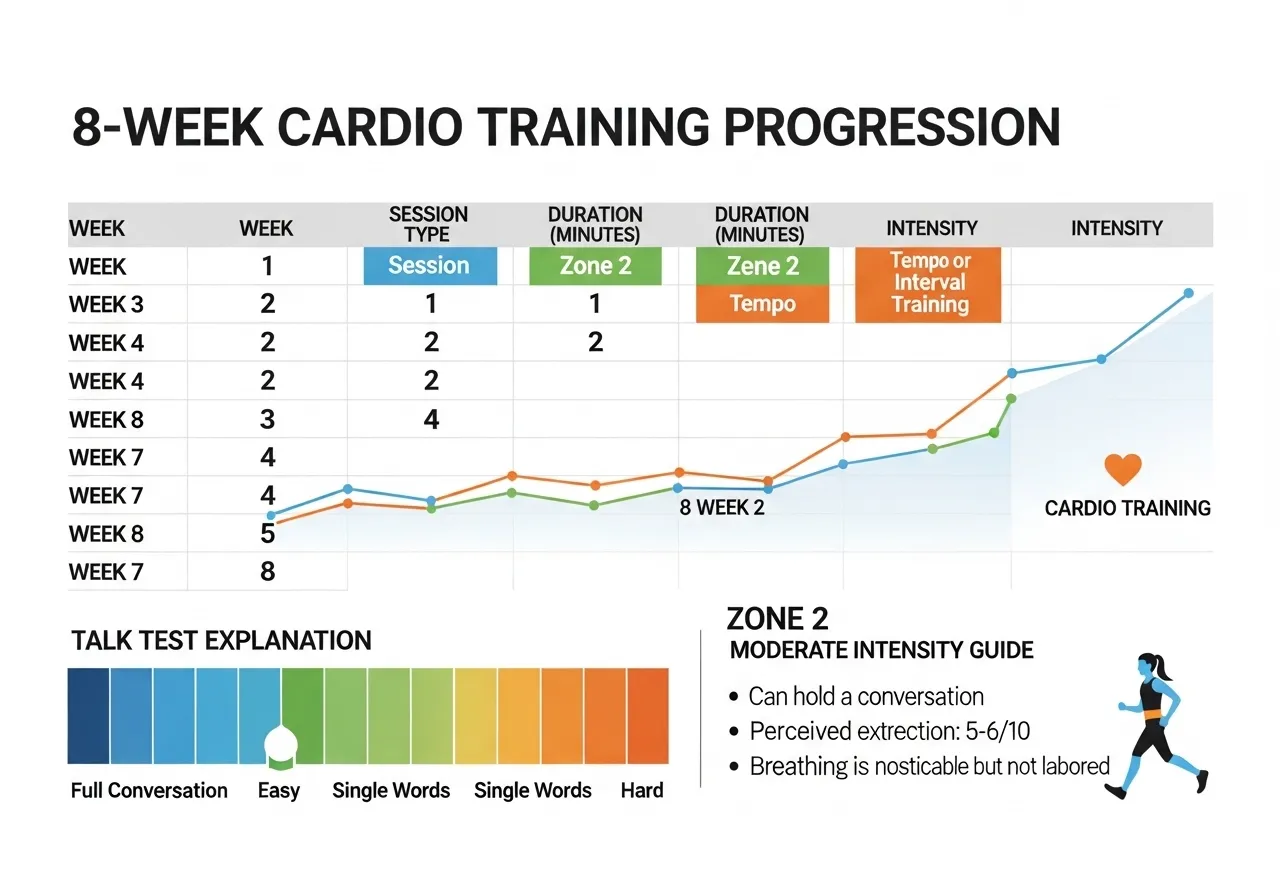
For beginners building a cardiovascular base from scratch, three to four sessions per week is the optimal starting frequency. This is enough to drive consistent adaptation while allowing the recovery time that prevents overuse injuries — the most common reason beginners quit cardio programs.
| Week | Sessions | Duration Each | Intensity |
|---|---|---|---|
| 1–2 | 3 per week | 20 minutes | Easy — conversation possible |
| 3–4 | 3 per week | 25 minutes | Moderate — short sentences possible |
| 5–6 | 4 per week | 25–30 minutes | Moderate — slightly effortful |
| 7–8 | 4 per week | 30 minutes | Moderate to hard |
The Talk Test: Your Built-In Intensity Guide
Heart rate monitors and fitness trackers are useful, but you already have a reliable intensity gauge built in — the talk test. During moderate-intensity cardio, you should be able to speak in short sentences but not hold a full conversation comfortably. If you can sing, go harder. If you cannot say more than one or two words, slow down.
Training at moderate intensity — sometimes called Zone 2 — is where most of your cardio sessions should sit, especially in the first 8–12 weeks. It builds the aerobic base that makes all future training more effective.
Rest and Recovery
Rest days are not wasted days — they are when adaptation occurs. Your cardiovascular system improves between sessions, not during them. Plan at least one full rest day between every two cardio sessions, and take two rest days per week in the first month.
Cardio for Beginners: Common Questions
How long before cardio feels easier?
Most beginners notice that the same activity feels meaningfully easier after 3–4 weeks of consistent training. The initial adaptation is largely neural and circulatory — your heart becomes more efficient at delivering blood, and your muscles become better at extracting oxygen from it.
By week 6–8, most beginners who started unable to jog for more than a minute can sustain 15–20 minutes of continuous light jogging. The improvement curve is steepest in the first two months, which is the most motivating period if you stick with it.
Is it normal to feel very out of breath at first?
Yes — completely normal. Cardiovascular fitness is one of the most rapidly adaptable qualities in the body, but it starts from wherever you currently are. Feeling very breathless during early sessions is not a sign that something is wrong — it is a sign that the training stimulus is doing its job.
The key is to work at an intensity that is challenging but sustainable. If you cannot speak at all, slow down. The goal in early training is to build duration at moderate intensity, not to push yourself to maximum effort every session.
Should I do cardio and strength training on the same day?
For beginners, doing both on the same day is perfectly fine — the training volumes involved are typically low enough that interference is minimal. If you do both in the same session, perform strength training first while you are freshest, then cardio afterward.
As training volume increases over months, separating cardio and heavy strength sessions onto different days produces better results for both qualities.
- Start with brisk walking — it is a legitimate cardiovascular stimulus for beginners and carries almost no injury risk
- Walk-run intervals provide a structured 8-week path from walking to continuous jogging
- Three to four sessions per week at moderate intensity builds the aerobic base that underpins all fitness progress
- The talk test is your built-in intensity guide — conversational but slightly effortful is the target zone
- Expect the same activity to feel noticeably easier after 3–4 weeks of consistent training