
The Benefits of Walking for Fitness: What the Evidence Actually Shows
Walking is the most accessible form of exercise available to most adults — requiring no equipment, no skill, and no gym membership. It is also one of the most consistently undervalued activities in fitness culture, frequently dismissed as “not real exercise” by people chasing more intense training modalities.
The evidence tells a different story. Regular walking produces documented cardiovascular, metabolic, cognitive, and mental health benefits — making it one of the most health-promoting activities a person can build into daily life.
The Evidence-Based Benefits of Regular Walking
Cardiovascular Health
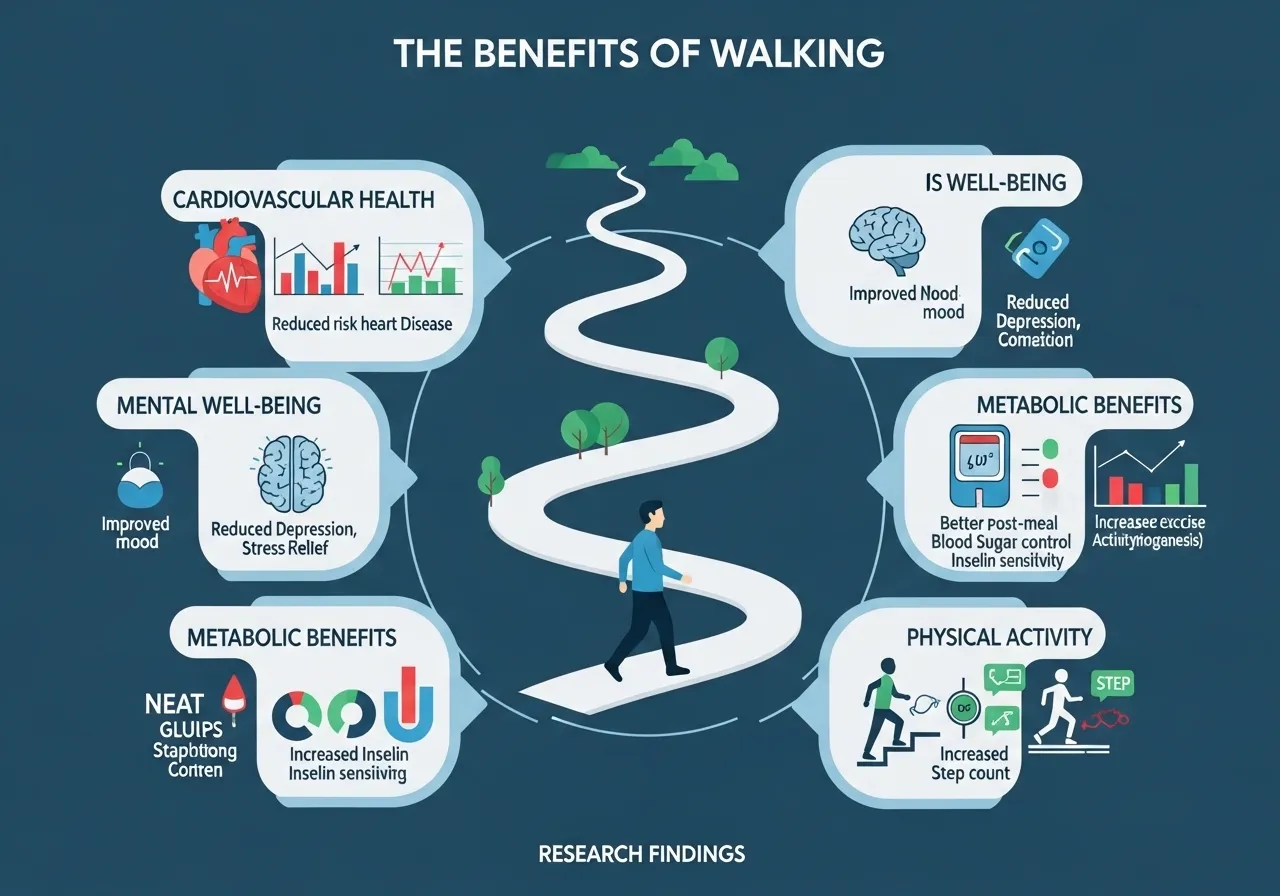
Walking is a genuine cardiovascular exercise. At a brisk pace (approximately 5–6.5 km/h), most adults reach 50–70% of maximum heart rate — sufficient to produce cardiovascular adaptations with consistent practice. Regular brisk walking is associated with reduced risk of heart disease, lower resting heart rate, improved blood pressure regulation, and better cholesterol profiles in long-term observational studies.
A landmark analysis of large cohort studies found that walking 7,000–10,000 steps per day is associated with significantly reduced all-cause mortality compared to lower step counts — with the strongest benefits appearing in the transition from very low activity (under 4,000 steps) to moderate activity (7,000+ steps). This suggests that the largest health return from walking comes from simply moving more than very little.
Mental Health and Cognitive Benefits
Walking’s effects on mental health are well-documented and practically significant. A single 20–30 minute walk produces acute improvements in mood, reduced anxiety, and improved cognitive function that last for several hours. Regular walking is associated with reduced risk of depression and anxiety disorders, improved sleep quality, and better stress management capacity.
Outdoor walking — particularly in natural settings — produces greater mood benefits than indoor walking at the same intensity, likely through a combination of nature exposure, sunlight, and the absence of the confined environment associated with indoor exercise.
Metabolic and Weight Management Benefits
While walking burns fewer calories per minute than more intense activities, its sustainability and accessibility make it uniquely valuable for contributing to total daily energy expenditure. Walking 30 minutes at a brisk pace burns approximately 150–200 calories for a 70 kg person — modest per session, but significant when accumulated across five or more sessions per week and multiplied over months.
Walking after meals — even a 10–15 minute gentle walk — has been shown to reduce post-meal blood glucose levels more effectively than remaining sedentary, a benefit particularly relevant for individuals managing blood sugar regulation.
How to Make Walking More Effective
Pace and Intensity
The intensity of walking matters for cardiovascular benefit. A stroll at 3 km/h produces minimal cardiovascular stress for most adults; a brisk walk at 5.5–6.5 km/h that makes conversation slightly effortful produces genuine cardiovascular benefit. A practical intensity target: you should be able to speak in short sentences but not sing comfortably.
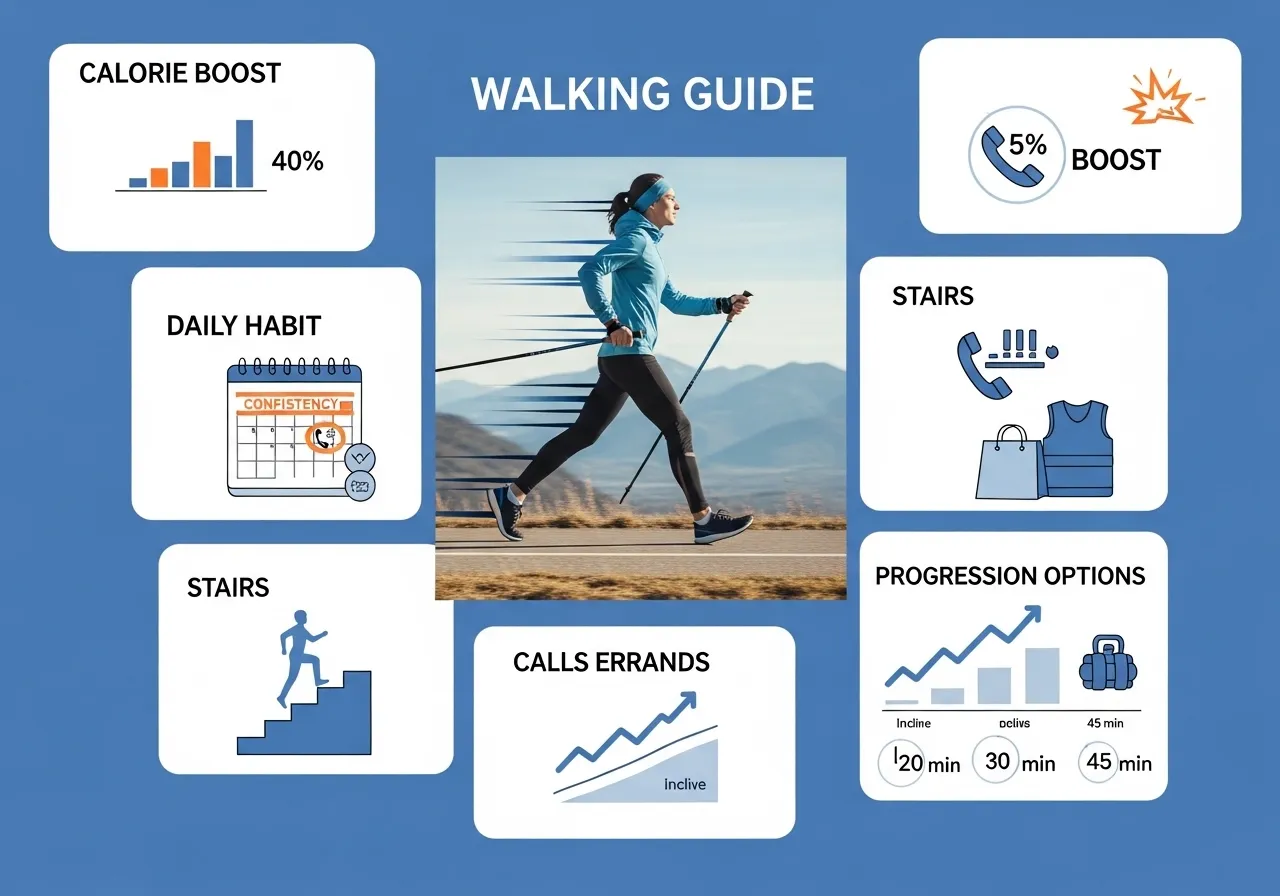
Nordic walking — using poles to engage the upper body — increases caloric expenditure by 20–46% compared to regular walking at the same pace and adds meaningful upper body and core engagement to what is otherwise primarily a lower body activity.
Building Walking Into Daily Life
Dedicated walking sessions are valuable, but the most sustainable approach is embedding walking into existing daily routines rather than treating it as a separate obligation:
- Walk or cycle for errands within 2–3 km rather than driving
- Take stairs instead of elevators for floors within 3–4 levels
- Walk during phone calls rather than sitting
- Get off public transport one stop early
- Schedule walking meetings at work when the meeting does not require screens
These embedded walking habits accumulate thousands of steps per day without requiring dedicated time allocation — and the cumulative health benefits are equivalent to the same steps performed in a deliberate session.
Progressing Your Walking Routine
Walking provides an ongoing stimulus for fitness improvement when the challenge is progressively increased. Progression options:
- Duration: Gradually increase session length from 20 to 30 to 45 minutes
- Pace: Increase speed from comfortable to brisk to fast
- Incline: Walking uphill significantly increases cardiovascular demand and lower body muscle engagement — hills, stairs, and treadmill incline all qualify
- Weighted vest: A light weighted vest (5–10% of bodyweight) increases caloric expenditure and bone-loading stimulus without changing pace or distance
Walking FAQ
How many steps per day should I aim for?
The “10,000 steps per day” target is widely cited but somewhat arbitrary — it originated from a Japanese marketing campaign in the 1960s rather than specific research. Current evidence suggests that 7,000–8,000 steps per day is associated with significant health benefits, and that each additional 1,000 steps above a low baseline produces incremental benefit up to approximately 10,000–12,000 steps, after which the additional benefit plateaus.
A more useful approach than obsessing over a daily step target is simply to be consistently more active than your current baseline — whatever that is.
Is walking enough exercise on its own?
For general health maintenance and longevity, consistent walking is genuinely sufficient — particularly for older adults or those returning from long periods of inactivity. For specific fitness goals such as building significant muscle, improving athletic performance, or achieving advanced cardiovascular fitness, walking alone is not sufficient and should be combined with more targeted training.
For the general adult population, meeting the WHO physical activity guidelines — 150 minutes of moderate activity per week — through brisk walking alone produces substantial health benefits compared to sedentary behavior.
Does walking count toward the recommended weekly exercise minutes?
Yes — brisk walking qualifies as moderate-intensity aerobic activity and fully counts toward the 150 minutes per week recommended by major health organizations including the WHO and American Heart Association. A 30-minute brisk walk five times per week meets this recommendation entirely.
- Regular brisk walking produces documented cardiovascular, metabolic, and mental health benefits
- 7,000–8,000 steps per day is associated with significant health improvements — 10,000 is not a magic threshold
- Embedding walking into daily routines (stairs, errands, calls) accumulates steps without dedicated time
- Incline, pace, and duration can all be increased progressively to maintain the training stimulus
- Brisk walking fully counts toward the 150 minutes of weekly moderate exercise recommended by health guidelines
Walking and Bone Health
Walking is a weight-bearing activity — meaning the skeleton bears load with each step. This mechanical loading stimulates bone remodeling and helps maintain bone density, particularly in the hip and lumbar spine — two areas most vulnerable to age-related bone loss.
While walking produces less osteogenic stimulus than higher-impact activities like running or jumping, it is significantly more accessible and sustainable for most adults, and consistent walking has been associated with reduced hip fracture risk in older populations.